
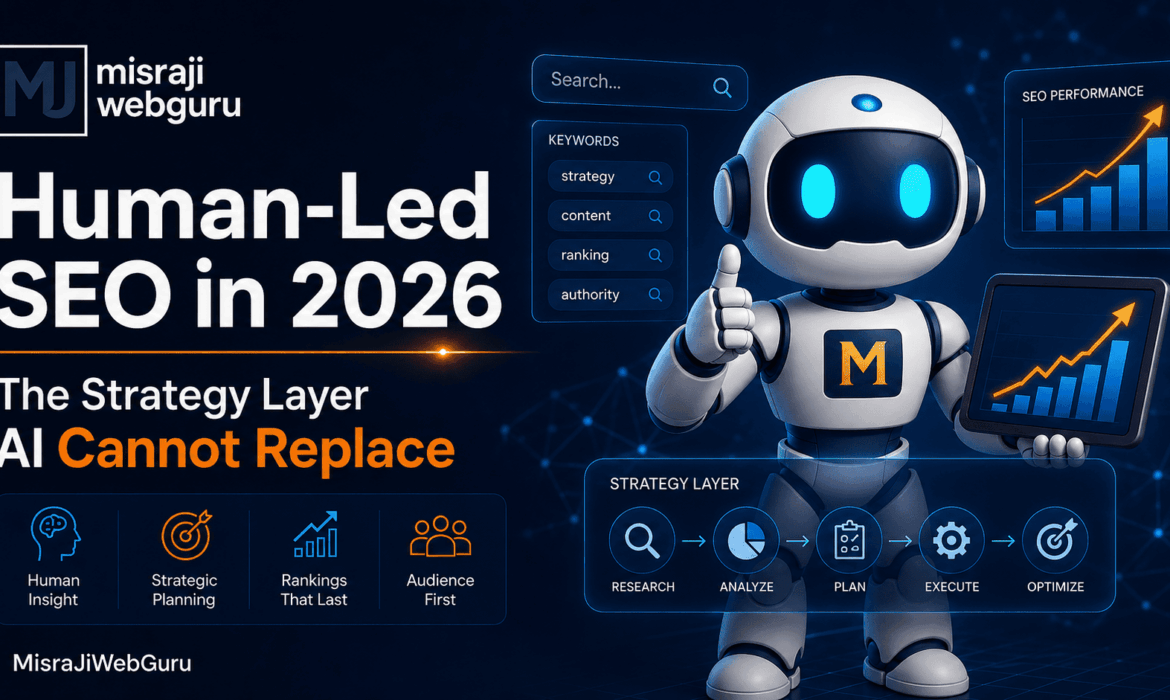
Key Takeaways
- Human-led SEO keeps business priorities, customer needs, and brand positioning at the centre of search strategy.
- AI can accelerate research, clustering, auditing, drafting, and analysis, but it cannot independently decide which opportunities are commercially valuable.
- Producing more AI-generated pages does not automatically create more authority, relevance, or visibility.
- Google continues to recommend unique, useful, people-first content for both traditional search and its generative AI experiences.
- The strongest SEO workflow is not human versus AI. It is human decision-making supported by controlled AI execution.
Human-Led SEO Is Becoming More Important, Not Less
Human-led SEO is becoming the defining advantage in a search environment filled with automated content, AI-generated summaries, AI Overviews, conversational search, and increasingly sophisticated marketing tools.
This may appear contradictory.
If AI in SEO can analyse keywords, classify intent, identify content gaps, draft articles, suggest internal links, inspect technical issues, and summarise performance, why should businesses continue investing in experienced SEO strategists?
Because completing an SEO task and making the correct business decision are not the same thing.
An AI system can produce a list of 500 keywords. It does not automatically know which 20 keywords support your most profitable services, which topics strengthen your desired market position, or which queries attract visitors who are likely to become customers.
It can generate an article in seconds. It cannot guarantee that the article contains an original argument, first-hand experience, defensible evidence, or a reason for someone to trust your brand instead of another result.
The critical question is no longer:
Can AI perform SEO tasks?
It clearly can. The more important question is:
Who decides which tasks are worth performing?
That is where human-led SEO begins.
Search Has Changed, but the Strategic Problem Has Not
Search is no longer limited to ten blue links.
A potential customer may discover a business through:
- A traditional organic result
- An AI Overview
- Google AI Mode
- A featured snippet
- A local result
- A video
- A product listing
- A forum discussion
- A social platform
- An AI-generated recommendation
Google acknowledged this expanded environment in June 2026 when it introduced dedicated Search Console reporting for visibility in generative AI features. The reports include impressions, appearing pages, countries, devices, and performance over time for features such as AI Overviews and AI Mode.
This gives SEO teams more information, but more data does not automatically produce better strategy.
A dashboard can show that a page appeared in an AI-generated result. It cannot independently answer:
- Was the appearance relevant to the company’s target audience?
- Did the page communicate the correct brand position?
- Was the query commercially important?
- Did the visibility influence branded searches or conversions?
- Should the company expand, update, consolidate, or abandon the topic?
These are interpretive decisions. They require business context, customer knowledge, competitive awareness, and judgment.
What Human-Led SEO Actually Means
Human-led SEO does not mean avoiding automation or manually completing every task.
It means that people remain responsible for the decisions that determine:
- What the business should become known for
- Which audiences it should prioritise
- Which problems its content should solve
- Which search opportunities support revenue
- What evidence the brand can uniquely contribute
- Which risks are acceptable
- How performance should be interpreted
- When the strategy should change
AI supports this decision system. It does not own it.
A practical human-led SEO model can be divided into four layers.
| Layer | Primary Responsibility | Appropriate Owner |
|---|---|---|
| Business direction | Goals, audience, margins and positioning | Human leadership |
| Search strategy | Priorities, intent, topics and competitive response | Human strategist |
| Execution | Research, briefs, drafts, audits and data processing | Human and AI |
| Quality control | Accuracy, originality, usefulness and brand alignment | Human reviewer |
The problem begins when organisations move AI from the execution layer into the decision layer without sufficient supervision.
Why Automation-First SEO Often Produces the Wrong Work Faster
AI is extremely effective at increasing production capacity.
That becomes dangerous when the underlying direction is weak.
Consider a software company that offers five services but earns most of its profit from only one. An automated keyword tool may find thousands of informational queries related to all five services.
A volume-led content system may begin publishing on every available topic.
Traffic could increase. The business may still gain very little.
Why?
Because the content system optimised for keyword availability rather than:
- Customer value
- Sales relevance
- Product differentiation
- Market positioning
- Conversion potential
- Long-term authority
The company did not necessarily create bad content. It created strategically misaligned content.
Human-led SEO prevents this by asking a harder question before production begins:
What business outcome should owning this search topic create?
Without that question, AI may help a company produce more pages while weakening the focus of the website.
The Five Decisions AI Should Not Make Alone
1. Which Opportunities Deserve Investment
Keyword volume is not business value.
A low-volume search from a decision-ready buyer may be worth more than a high-volume query attracting students, researchers, competitors, or people with no purchasing intent.
A strategist evaluates an opportunity through multiple filters:
- Relevance to the company’s services
- Connection to customer pain points
- Revenue potential
- Competitive difficulty
- Existing authority
- Resource requirements
- Sales-cycle position
- Brand-building value
AI can calculate and organise these signals. The final prioritisation requires commercial context.
A useful scoring model is:
\text{Execution Cost}
$$
The numbers do not need to be perfect. The purpose is to stop search volume from becoming the only decision criterion.
2. What the Searcher Truly Needs
Search intent is often treated as a fixed label:
- Informational
- Navigational
- Commercial
- Transactional
Real behaviour is more complicated.
Someone searching for “best CRM for small business” may need:
- A product comparison
- Pricing guidance
- Implementation advice
- Integration requirements
- A migration checklist
- Evidence from similar businesses
- Reassurance about data security
AI can classify the query as commercial investigation. A strategist must determine what information will reduce uncertainty and move the customer forward.
This distinction matters because successful content does not merely answer a query. It helps the reader make a decision.
3. What Makes the Content Worth Citing
AI can summarise widely available information efficiently.
That is precisely why summary-only content is becoming less defensible.
When every competitor can generate similar definitions, lists, and explanations, competitive value moves toward information that cannot be reproduced through a generic prompt.
That may include:
- Original research
- Internal performance data
- First-hand experience
- Customer questions
- Expert commentary
- Process screenshots
- Experiments
- Case evidence
- Contrarian analysis
- Proprietary frameworks
Google’s guidance for generative AI search recommends unique, expert-led, non-commodity content rather than pages that merely repeat common knowledge. It also states that existing technical SEO and people-first content principles remain foundational for generative AI visibility.
The strategist’s role is therefore not just to approve an AI draft.
The strategist must decide what the organisation knows that the draft could not have produced independently.
4. How Much Automation Is Too Much
Google does not prohibit content simply because AI helped create it.
Its guidance focuses on accuracy, quality, relevance, usefulness, and whether automation is being used to create many pages without adding value. Large-scale generation designed primarily to manipulate visibility may violate Google’s scaled content abuse policy.
This creates an important distinction:
Responsible AI-supported content
- Begins with a real audience need
- Contains expert input
- Is fact-checked
- Adds original value
- Supports the site’s purpose
- Receives meaningful human review
Automation-first content
- Begins with keyword quantity
- Repackages existing pages
- Uses generic claims
- Covers unrelated topics
- Receives superficial editing
- Exists mainly to attract search visits
The difference is not which AI tool was used.
The difference is whether someone exercised editorial and strategic judgment.
5. When the Strategy Needs to Change
Automated systems generally optimise according to the inputs, goals, and rules they have been given.
Markets do not remain fixed.
A strategy may need to change because:
- Customer language has shifted
- A competitor introduced a new category
- Search results changed format
- An AI Overview reduced clicks
- A product became more profitable
- Conversion quality declined
- A topic began attracting the wrong audience
- A regulation changed what can be claimed
- A new search platform became relevant
AI can detect anomalies and summarise changes. Human strategists determine what those changes mean and whether the business should respond.
Where AI in SEO Creates Genuine Value
Rejecting autonomous strategy does not mean rejecting AI.
The best human-led SEO systems use AI aggressively where speed and scale create an advantage.
Research
AI can help:
- Group large keyword sets
- Identify recurring questions
- Analyse customer reviews
- Compare competitor topics
- Extract themes from sales calls
- Summarise Search Console exports
- Discover content gaps
Production
AI can assist with:
- Content outlines
- First drafts
- Metadata variations
- FAQ suggestions
- Schema preparation
- Internal-link recommendations
- Image briefs
- Content repurposing
Technical SEO
AI can accelerate:
- Log-file interpretation
- Template analysis
- Redirect mapping
- Duplicate-pattern detection
- Structured-data validation
- Crawl-report summarisation
- Prioritisation of recurring errors
Measurement
AI can help teams:
- Detect unusual traffic changes
- Compare landing-page groups
- Summarise ranking movement
- Segment branded and non-branded performance
- Analyse AI-search visibility
- Generate recurring reports
The principle is simple:
Use AI to reduce processing time, not to remove accountability.
The Human-Led SEO Operating System
Businesses do not need a complicated transformation program to implement human-led SEO.
They need a controlled workflow.
Step 1: Start With the Business Objective
Define the desired outcome before opening a keyword tool.
For example:
- Generate qualified leads for AI automation services
- Increase bookings for local consultations
- Build authority in enterprise cybersecurity
- Improve product-category revenue
- Reduce dependence on paid acquisition
Step 2: Convert the Objective Into Search Problems
Identify what the audience must understand before taking action.
For an AI automation company, those problems may include:
- Which processes can be automated?
- What does implementation cost?
- Which systems can be integrated?
- How is customer data protected?
- How quickly can ROI be measured?
Step 3: Use AI to Expand the Research
AI can then process:
- Keyword data
- Search-result patterns
- Competitor pages
- Customer reviews
- Support tickets
- Sales objections
- Existing website content
The output is research material, not the final strategy.
Step 4: Apply Human Prioritisation
A strategist decides:
- Which problem should be solved first
- Which page format fits the intent
- What original evidence is available
- How the topic supports positioning
- What action the reader should take
Step 5: Produce With AI Assistance
AI may create the outline, organise research, prepare questions, or generate a first draft.
A subject-matter expert then adds:
- Experience
- Accuracy
- Examples
- Original analysis
- Brand language
- Commercial relevance
Step 6: Review for Usefulness, Not Just Keywords
Google’s people-first content guidance asks whether readers will leave feeling they learned enough to achieve their goal and whether the page demonstrates first-hand expertise and depth of knowledge. It also warns against extensive automation across many topics, summarising other sources without adding value, and writing to an assumed “ideal” word count.
A human review should therefore ask:
- Does this page solve the reader’s real problem?
- What can the reader do after reading it?
- Which section contains original value?
- Are the claims accurate and supportable?
- Does the page fit the website’s purpose?
- Is anything included only for ranking?
Step 7: Measure the Right Outcome
Do not measure success only through the number of published pages.
Track:
- Qualified organic leads
- Assisted conversions
- Branded search growth
- Non-branded commercial visibility
- Returning visitors
- Search-to-sales conversion quality
- AI Overview and AI Mode visibility
- Content-assisted pipeline
- Revenue by landing-page group
BrightEdge reported in February 2026 that AI Overviews appeared for approximately 48 percent of its tracked queries, while about 52 percent still had no AI Overview. Its study also found significant differences between traditional page-one rankings and the sources cited in AI Overviews, showing why brands need to measure both environments rather than treating them as identical.
SEO Should Become a Business Intelligence Function
One of the greatest missed opportunities in SEO is keeping search data inside the SEO team.
Search behaviour can reveal:
- Which customer problems are increasing
- Which product features create confusion
- Which objections prevent purchases
- Which competitors are entering consideration
- Which language customers naturally use
- Which services are gaining demand
- Which topics require stronger education
This intelligence can improve more than content.
Paid Media
Organic query and landing-page data can reveal which messages and customer problems deserve paid testing.
Sales
Search questions can expose the objections prospects need answered before a conversation.
Product Development
Recurring searches may reveal missing features, integration demands, or unmet use cases.
Email Marketing
Intent patterns can help separate educational audiences from comparison-ready and purchase-ready prospects.
Conversion Optimisation
Search context can explain what visitors expected to find before reaching a page, improving messaging and test hypotheses.
Human-led SEO connects these signals because a strategist can understand the relationship between search behaviour and the broader business.
An automated report may show a rising query.
A human asks why the query is rising and what the organisation should do about it.
A Practical Human–AI Responsibility Matrix
| SEO Activity | AI’s Role | Human Role |
| Keyword research | Collect, expand and cluster | Select commercially relevant opportunities |
| Intent analysis | Classify patterns | Interpret customer needs and uncertainty |
| Content briefs | Build structure and gather questions | Define angle, evidence and positioning |
| Drafting | Produce an initial version | Add expertise, originality and accuracy |
| Technical audits | Detect and group issues | Evaluate risk and business priority |
| Competitor analysis | Compare pages and visibility | Explain why competitors are succeeding |
| Reporting | Process and summarise data | Decide what the data means |
| AI-search optimisation | Track citations and appearances | Determine strategic response |
| Content governance | Flag possible issues | Approve, revise, consolidate or reject |
| Strategy | Supply intelligence | Retain ownership |
FAQs
What is human-led SEO?
Human-led SEO is an approach in which experienced people retain control over strategic decisions such as prioritisation, audience selection, content positioning, quality standards, risk management, and performance interpretation. AI supports research and execution but does not independently control the program.
Can AI replace an SEO strategist?
AI can replace or accelerate individual SEO tasks, but a task is not the same as a strategy. An SEO strategist connects search data with business objectives, customer behaviour, brand positioning, competitive context, and acceptable risk.
Is AI-generated content bad for SEO?
AI-generated content is not automatically bad or prohibited. The risk arises when automation is used to publish large quantities of unoriginal or low-value pages primarily to manipulate visibility. AI-supported content should be accurate, useful, relevant, original, and meaningfully reviewed by humans.
How should AI be used in SEO?
AI is best used for data processing, keyword clustering, research assistance, content outlining, initial drafting, technical analysis, quality checks, and performance summaries. Humans should remain responsible for strategy, expertise, factual approval, brand alignment, and final publication decisions.
Does human-led SEO work for AI Overviews?
Yes. Google’s current guidance states that foundational SEO practices, technical accessibility, unique content, and people-first usefulness remain important for visibility in its generative AI search features. Google does not require special AI markup or an entirely separate content strategy for AI Overviews.
Conclusion
Human-led SEO is not a rejection of artificial intelligence. It is a more disciplined way to use it.
AI can make SEO teams faster. It can process more data, produce stronger starting points, identify patterns, and reduce repetitive work.
But speed becomes valuable only after the direction is correct.
The organisations building durable search visibility will not be those that automate the highest number of tasks. They will be those that combine machine efficiency with human understanding of customers, markets, brands, risk, and business value.
The winning structure is therefore not human versus AI.
It is:
- Humans setting the destination
- AI accelerating the journey
- Experts protecting quality
- Data informing decisions
- Business outcomes determining success
At MISRAJIWEBGURU, we build AI-assisted search systems without removing the strategy, expertise, and human accountability that sustainable growth requires.
Ready to move from automated content production to an intelligent human-led SEO system? Connect with MisraJiWebGuru and build a search strategy designed for rankings, AI visibility, authority, and measurable business growth.

 All Rights Reserved.