
Introduction
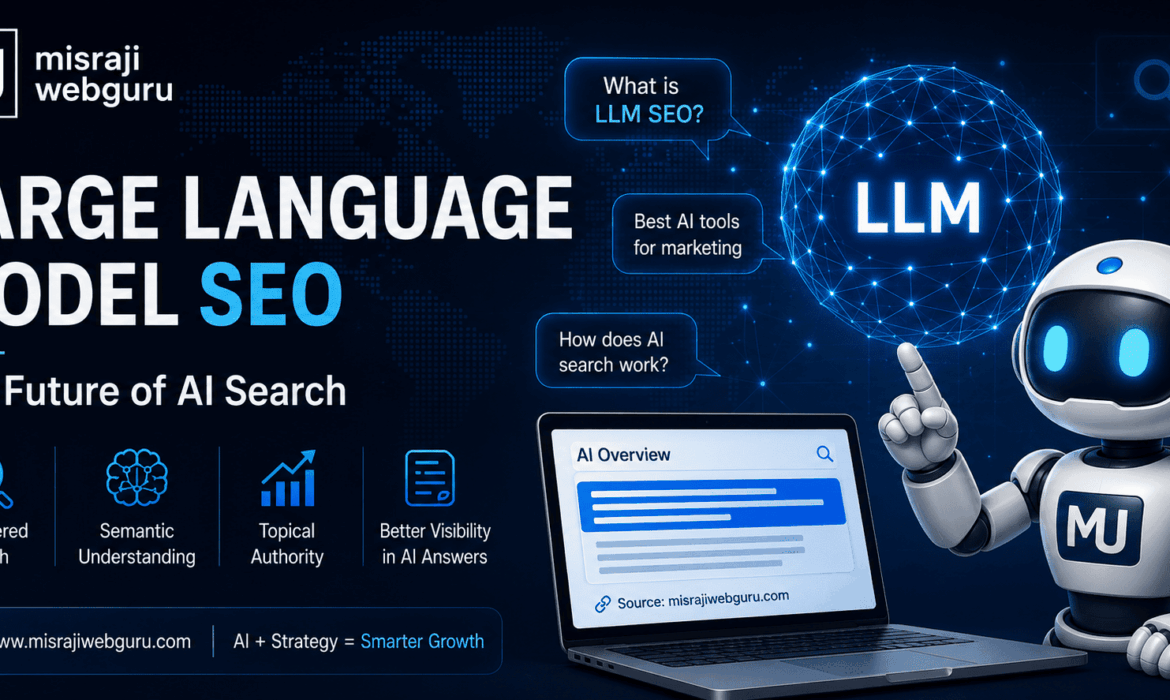
Large Language Model SEO Search is undergoing its biggest transformation since the introduction of modern search engines. Instead of simply matching keywords to web pages, today’s AI-powered systems understand language, context, and user intent through Large Language Models (LLMs). Platforms such as ChatGPT, Google AI Overviews, Gemini, Claude, and Perplexity are changing how people discover information, making Large Language Model SEO an essential strategy for businesses that want to remain visible.
Unlike traditional SEO, which primarily focuses on ranking webpages in search engine results, Large Language Model SEO aims to optimize content so that AI systems can understand, retrieve, and reference it accurately when generating answers. As AI-driven search continues to evolve, businesses that adapt their content strategies today will be better positioned to earn visibility, authority, and trust in the future of search.
What Is Large Language Model SEO?
Large Language Model SEO is the practice of optimizing digital content so that Large Language Models (LLMs) can accurately understand, interpret, retrieve, and reference it when generating responses to user queries. While traditional SEO focuses on improving rankings within search engine result pages (SERPs), LLM SEO focuses on making content comprehensible and trustworthy for AI-powered systems that generate conversational answers.
Large Language Models are advanced artificial intelligence systems trained on vast collections of books, websites, research papers, technical documentation, and other publicly available information. Rather than retrieving information through simple keyword matching, they identify semantic relationships between concepts, recognize entities, interpret context, and predict the most relevant response based on patterns learned during training or through retrieval systems.
This shift fundamentally changes how content should be created. Instead of writing solely for search engine crawlers, businesses must produce content that demonstrates topical expertise, logical organization, factual accuracy, and semantic completeness. Well-structured articles, clearly defined concepts, authoritative explanations, and strong contextual relationships are significantly easier for AI systems to interpret than pages optimized only around keyword repetition.
In practice, Large Language Model SEO combines traditional SEO principles with semantic optimization, entity-based content development, structured information architecture, and authoritative knowledge creation. The objective is not simply to rank higher in search engines but to increase the likelihood that AI-powered platforms reference your content as a reliable source when answering users’ questions.
Why Large Language Model SEO Is Becoming Essential
User behavior is rapidly shifting from traditional keyword searches to conversational interactions with AI assistants. Rather than searching for multiple webpages and comparing results manually, users increasingly expect a single, comprehensive answer generated by an intelligent system.
This evolution has significant implications for businesses. If your content cannot be understood, trusted, or retrieved by Large Language Models, it becomes less likely to appear in AI-generated responses—even if it ranks well in conventional search results.
LLM SEO addresses this challenge by helping businesses create content that is both search engine friendly and AI understandable. It emphasizes semantic clarity, topical authority, structured knowledge, and high-quality information that supports accurate AI reasoning.
Organizations that invest in Large Language Model SEO today are preparing not only for better visibility in search engines but also for increased exposure across AI-powered assistants, conversational search platforms, enterprise AI systems, and future answer engines. As AI becomes the primary interface for information discovery, optimizing for language models will become as important as optimizing for search engines was over the past two decades.
Why Traditional SEO Alone Is No Longer Enough
For more than two decades, traditional Search Engine Optimization has focused on improving a webpage’s visibility within Search Engine Results Pages (SERPs). Core ranking factors such as keyword optimization, backlinks, technical SEO, page speed, structured metadata, and user experience continue to play a vital role in achieving organic rankings.
However, the emergence of Large Language Models (LLMs) has fundamentally changed how information is discovered and consumed.
Instead of presenting users with a list of webpages, AI-powered platforms increasingly generate comprehensive answers by synthesizing information from multiple trusted sources. Systems such as Google AI Overviews, ChatGPT, Gemini, Claude, and Perplexity evaluate information differently from conventional search engines. Rather than prioritizing exact keyword matching, they focus on semantic relationships, factual consistency, contextual understanding, topical authority, and source credibility.
This shift means that ranking on the first page of Google does not automatically guarantee visibility within AI-generated responses. A webpage may achieve excellent traditional rankings while remaining absent from conversational AI recommendations if its content lacks semantic depth, clear knowledge organization, or demonstrable expertise.
Traditional SEO therefore remains essential, but it is no longer sufficient on its own. Businesses must complement conventional optimization techniques with Large Language Model SEO, ensuring their content is understandable not only by search engine crawlers but also by intelligent language models that increasingly influence how users access information.
How Large Language Models Understand and Retrieve Information
Understanding Large Language Model SEO begins with understanding how modern language models process information. Unlike traditional search engines that primarily index webpages and rank them based on hundreds of predefined signals, Large Language Models are designed to understand relationships between words, concepts, entities, and contexts.
When a user submits a question to an AI assistant, the model does not simply search for pages containing identical keywords. Instead, it converts both the user’s query and available knowledge into mathematical representations known as embeddings. These vector representations capture the semantic meaning of language, allowing the model to recognize that different phrases can express the same underlying concept.
For example, the following questions have different wording but nearly identical intent:
- How can I improve my website ranking?
- What is the best way to optimize my website for search engines?
- How do I increase organic traffic?
Traditional keyword-based systems might treat these as separate searches, whereas a Large Language Model understands that all three relate to SEO optimization and retrieves conceptually relevant information.
Many modern AI systems further enhance this capability using Retrieval-Augmented Generation (RAG). Instead of relying solely on knowledge acquired during training, RAG enables an AI model to retrieve current, authoritative documents before generating a response. This significantly improves factual accuracy and allows AI assistants to reference recent information.
For businesses, this changes the objective of content creation. Instead of writing isolated articles targeting individual keywords, organizations must develop comprehensive resources that clearly explain concepts, establish relationships between topics, and demonstrate expertise.
Large Language Models also identify entities such as companies, products, technologies, people, and locations. They analyze how these entities relate to one another across the web, creating knowledge graphs that strengthen contextual understanding. Websites that consistently publish accurate, well-structured, and interconnected content are more likely to be recognized as authoritative sources within these systems.
This is precisely where Large Language Model SEO differs from conventional optimization. Success is no longer measured solely by ranking positions but by whether AI systems can confidently understand, retrieve, and reference your content when generating reliable answers for users.
How Large Language Model SEO Works
Unlike conventional SEO, which primarily focuses on improving rankings within search engine result pages, Large Language Model SEO is designed to help artificial intelligence systems understand, evaluate, and reference content with greater confidence. The objective is not merely to rank higher but to become a trusted knowledge source that AI-powered platforms can interpret accurately when answering user questions.
Large Language Models analyze content differently from traditional search engines. Instead of relying heavily on keyword frequency or isolated ranking signals, they examine semantic relationships, contextual meaning, entity connections, topical depth, and factual consistency. Every section of a webpage contributes to how the model understands the subject as a whole.
This means that successful LLM SEO requires content to be structured around concepts rather than individual keywords. Articles must answer related questions comprehensively, define important terms clearly, establish logical relationships between topics, and provide trustworthy information supported by expertise.
The following principles represent the core components of Large Language Model SEO and explain how businesses can optimize their content for the next generation of AI-powered search systems.
Semantic Understanding – Writing for Meaning Instead of Keywords
Traditional SEO often encouraged content creators to repeat keywords throughout a page to improve relevance. While modern search engines have already moved beyond this approach, Large Language Models take semantic understanding even further.
LLMs interpret meaning, not just words. They recognize synonyms, related concepts, contextual relationships, and the intent behind a user’s question. For example, phrases such as AI chatbot, virtual assistant, conversational AI, and intelligent customer support may describe different aspects of the same broader concept. Rather than treating them as separate keywords, AI understands how they are connected.
For businesses, this means content should explain ideas comprehensively instead of focusing on keyword density. Articles should naturally introduce related terminology, define important concepts, and answer follow-up questions that users are likely to ask.
Semantic optimization also improves the likelihood that AI assistants can extract accurate information from a page because the content presents a complete understanding of the subject rather than isolated keyword matches.
Entity Optimization – Helping AI Recognize Who and What You Are
Large Language Models organize knowledge around entities rather than individual words. An entity can be a person, company, product, technology, service, location, or any uniquely identifiable concept.
For example, “MisraJiWebGuru” is an entity. Likewise, “ChatGPT,” “Google Gemini,” “SEO,” and “Artificial Intelligence” are recognized entities with relationships that AI systems continuously learn from structured and unstructured information.
Entity optimization involves making these relationships explicit. Instead of mentioning a company or technology once, explain what it is, how it works, how it relates to other concepts, and why it is important. Consistency in branding, terminology, and structured information also helps AI models associate your website with a specific area of expertise.
The stronger your entity signals become across your website, the easier it is for AI systems to recognize your authority within that subject domain.
Building Topic Clusters Instead of Isolated Articles
Large Language Models evaluate knowledge holistically. A single article may answer one question effectively, but AI systems gain greater confidence when multiple related articles collectively demonstrate expertise.
This is where topic clusters become essential.
Instead of publishing unrelated blog posts, businesses should develop interconnected content around a central theme. For example, a pillar page on AI-powered marketing can be supported by detailed articles covering AI in SEO, AI Agents for Business, Large Language Model SEO, Generative Engine Optimization (GEO), AI Search Optimization, and AI Chatbots.
Each article explores a specific topic while linking naturally to related resources. This interconnected structure helps AI models understand the breadth and depth of your expertise, reinforcing topical authority.
For both search engines and Large Language Models, a website that consistently publishes connected, high-quality content is far more trustworthy than one containing isolated articles with no semantic relationship.
Structured Content Makes AI Understanding Easier
One of the biggest advantages of well-written content is clarity. Large Language Models process information more effectively when ideas are presented in a logical and predictable structure.
Clear headings, descriptive subheadings, short paragraphs, bullet points, comparison tables, definitions, FAQs, and schema markup all contribute to better information extraction. Rather than forcing AI to infer relationships between scattered ideas, structured content explicitly communicates how concepts connect.
For example, if an article defines a term, explains how it works, outlines its benefits, compares it with alternatives, and answers common questions, the information becomes significantly easier for AI systems to retrieve and summarize accurately.
Structured content not only improves user experience but also increases the probability that AI-powered platforms will reference your website when generating answers.
EEAT Signals Build AI Trust
Large Language Models are increasingly influenced by the same quality signals that modern search engines value. Although AI systems do not evaluate websites exactly like Google’s ranking algorithms, they consistently prioritize information that demonstrates expertise, authority, and trustworthiness.
This aligns closely with Google’s Experience, Expertise, Authoritativeness, and Trustworthiness (EEAT) framework.
Businesses can strengthen these signals by publishing original research, citing reliable sources, showcasing real-world experience, maintaining accurate information, and ensuring content is written by knowledgeable professionals.
Over time, consistent publication of trustworthy content helps establish a website as a dependable knowledge source, increasing the likelihood that AI systems will reference its information when answering user queries.
Large Language Model SEO vs Traditional SEO
| Aspect | Traditional SEO | Large Language Model SEO |
|---|---|---|
| Primary Objective | Rank webpages in search engine results | Become a trusted source for AI-generated answers |
| Search Focus | Keywords and search queries | User intent, context, and semantic meaning |
| Content Strategy | Individual keyword optimization | Comprehensive topic coverage and knowledge development |
| Optimization Method | Keywords, backlinks, metadata, technical SEO | Entities, semantic relationships, structured knowledge, topical authority |
| Content Structure | SEO-friendly pages | AI-readable, logically organized knowledge resources |
| Authority Signals | Domain authority, backlinks, EEAT | EEAT, entity recognition, factual consistency, citation potential |
| Success Metric | Rankings, impressions, organic traffic | AI citations, answer inclusion, topical trust, authority recognition |
| User Experience | Optimized for webpage visitors | Optimized for both humans and AI reasoning systems |
| Long-Term Strategy | Search visibility | Knowledge authority and AI discoverability |
Best Practices for Large Language Model SEO
Optimizing for Large Language Models requires more than inserting keywords or improving technical SEO. The objective is to publish content that AI systems can confidently interpret, verify, and reference when answering user questions.
The following best practices are based on principles from semantic search, information retrieval, knowledge graphs, and modern AI systems. Together, they help establish your website as an authoritative knowledge source capable of performing across both traditional search engines and AI-powered answer engines.
Create Comprehensive, Topic-Centric Content
Large Language Models favor comprehensive resources over fragmented information. Instead of publishing multiple short articles targeting similar keywords, develop in-depth content that explores a topic from multiple perspectives.
For example, an article about Large Language Model SEO should explain what it is, how it works, why it matters, practical implementation strategies, common mistakes, and future developments. Covering the complete subject helps AI models understand your expertise while reducing informational gaps.
Comprehensive content also encourages longer user engagement, increases internal linking opportunities, and strengthens topical authority across your website.
Optimize for Entities, Not Just Keywords
Keywords describe search intent, but entities describe knowledge.
When discussing AI technologies, consistently define and explain important entities such as ChatGPT, Gemini, Claude, Perplexity, Google AI Overviews, Retrieval-Augmented Generation (RAG), semantic search, and knowledge graphs. Establish clear relationships between these concepts so AI systems can better understand your expertise.
Entity optimization improves contextual relevance and increases the likelihood that your website will be associated with specific subject areas.
Build Strong Internal Topic Networks
AI systems evaluate websites as interconnected knowledge ecosystems rather than isolated webpages.
Every new article should naturally connect with related resources. For example, this article should link to:
- AI in Digital Marketing
- AI in SEO Optimization
- AI Agents for Business
- Google AI Overview SEO
- Generative Engine Optimization (future article)
These semantic relationships reinforce topical authority while improving navigation for both users and AI systems.
Structure Content for AI Readability
Well-structured content is easier for AI systems to analyze and summarize.
Use:
- Clear heading hierarchy (H1–H3)
- Definitions before explanations
- Short paragraphs
- Comparison tables
- Bullet points
- FAQs
- Schema markup
Rather than hiding important information within long blocks of text, organize it logically so both humans and AI models can locate relevant information quickly.
Structured content increases the probability of appearing in AI-generated summaries and answer engines.
Publish Original Research and Expert Insights
AI systems increasingly prioritize original information over repetitive content. While summarizing publicly available knowledge has value, publishing unique perspectives, proprietary frameworks, industry case studies, original data, or expert commentary helps distinguish your website from thousands of similar pages.
Businesses should regularly contribute:
- Original research
- Performance benchmarks
- Case studies
- Industry observations
- Practical implementation frameworks
This type of content strengthens EEAT signals while making your website a more valuable reference for AI systems.
Common Mistakes Businesses Make with Large Language Model SEO
As interest in Large Language Model SEO grows, many businesses assume that simply using AI tools or publishing AI-generated content is enough to improve visibility in AI-powered search. In reality, several common mistakes prevent websites from becoming trusted sources for Large Language Models.
1. Treating LLM SEO as Traditional SEO
Many businesses continue optimizing only for rankings and keywords while ignoring semantic relationships, entity optimization, and topical authority. Although traditional SEO remains important, it should now be complemented with strategies that help AI systems understand knowledge, not just webpages.
2. Publishing Generic AI-Generated Content
AI can accelerate content creation, but publishing unedited, repetitive, or low-value articles reduces credibility. Large Language Models increasingly favor content that demonstrates originality, expertise, and unique insights rather than information copied from existing sources.
3. Ignoring Entity and Contextual Relationships
Mentioning technologies, companies, or services without explaining their relationships limits how effectively AI can understand the subject. Every important concept should be clearly defined and connected to related ideas.
4. Weak Internal Linking
Publishing isolated articles prevents AI systems from recognizing topical expertise. A structured network of interconnected content strengthens semantic understanding and topical authority.
5. Failing to Maintain Content Freshness
Artificial intelligence evolves rapidly. Outdated articles with obsolete examples, statistics, or implementation strategies gradually lose relevance. Regular updates ensure that both users and AI systems continue to view your content as reliable and authoritative.
The Future of Large Language Model SEO
The future of search will be defined less by ranking webpages and more by delivering trusted, conversational answers. As Large Language Models continue to evolve, businesses must prepare for a search ecosystem where AI assistants become the primary interface between users and information.
Several trends are already shaping this transition:
- Answer engines will complement—and in some cases replace—traditional search result pages for informational queries.
- Multimodal AI will evaluate text, images, videos, audio, and structured data together rather than treating them as separate content types.
- Entity-based search will become increasingly important, rewarding organizations that consistently establish expertise around specific subjects.
- Personalized AI responses will adapt answers based on user preferences, history, location, and context.
- Retrieval-Augmented Generation (RAG) will continue improving factual accuracy by combining language models with real-time information retrieval.
These developments indicate that SEO is expanding beyond search engines into a broader discipline centered on knowledge management and AI discoverability.
Businesses that begin implementing Large Language Model SEO today will be significantly better prepared for this transition than those waiting for AI search to become mainstream.
How MisraJiWebGuru Helps Businesses Succeed with Large Language Model SEO
At MisraJiWebGuru, we believe the future of digital visibility extends far beyond conventional search engine optimization. Modern businesses require strategies that make their websites understandable to both search engines and intelligent AI systems.
Our approach combines technical SEO with semantic content architecture, entity optimization, AI-driven content strategy, structured data implementation, and topical authority development. Instead of focusing solely on rankings, we help businesses build knowledge ecosystems that are more likely to be referenced by AI-powered platforms.
Our services include:
- AI-driven SEO strategy and implementation
- Large Language Model SEO consulting
- Semantic content planning
- Topic cluster development
- Structured data optimization
- AI-ready website architecture
- Technical SEO audits
- Content optimization for AI-powered search
- Digital authority building
Whether your goal is improving organic visibility, increasing AI discoverability, or preparing your business for the future of search, our team develops strategies aligned with the rapidly evolving AI ecosystem.
Frequently Asked Questions
1. What is Large Language Model SEO?
Large Language Model SEO is the practice of optimizing digital content so AI systems such as ChatGPT, Google AI Overviews, Gemini, Claude, and other language models can better understand, retrieve, and reference your content when generating responses.
2. How is LLM SEO different from traditional SEO?
Traditional SEO focuses on improving search engine rankings, while LLM SEO emphasizes semantic understanding, topical authority, entity optimization, and AI discoverability within conversational search systems.
3. Will Large Language Model SEO replace traditional SEO?
No. Traditional SEO remains essential for crawlability, indexing, and rankings. Large Language Model SEO complements traditional SEO by preparing content for AI-powered search experiences.
4. Why is semantic SEO important for Large Language Models?
Large Language Models interpret meaning rather than simply matching keywords. Semantic SEO helps AI systems understand concepts, relationships, and user intent more accurately.
5. What role do entities play in LLM SEO?
Entities provide context. Clearly defining companies, products, technologies, people, and concepts helps AI systems establish relationships and recognize your website’s expertise within a particular domain.
6. Does structured content improve AI visibility?
Yes. Clear headings, logical organization, tables, FAQs, schema markup, and well-structured content make information easier for AI systems to interpret and summarize.
7. Can AI-generated content rank in AI search?
Yes, but only when it is carefully reviewed, fact-checked, enriched with original insights, and aligned with EEAT principles. Generic AI-generated content alone rarely builds lasting authority.
8. How can businesses prepare for AI-powered search?
Businesses should focus on semantic content, entity optimization, topic clusters, structured data, technical SEO, and publishing authoritative, regularly updated content.
9. Which AI platforms benefit from LLM SEO?
LLM SEO helps improve discoverability across AI-powered platforms such as ChatGPT, Google AI Overviews, Gemini, Claude, Perplexity, Microsoft Copilot, and future conversational search systems.
10. Why should businesses invest in Large Language Model SEO now?
As AI becomes a primary gateway to information, businesses that establish authority today will be better positioned to earn visibility, citations, and trust within future AI-driven search experiences.
Conclusion
The evolution of search is no longer centered solely on ranking webpages—it is increasingly focused on delivering accurate, contextual, and trustworthy answers through artificial intelligence. Large Language Model SEO represents the next stage of this transformation, helping businesses optimize their content not only for search engines but also for intelligent AI systems that influence how users discover information.
Organizations that continue relying exclusively on conventional SEO strategies risk missing opportunities as conversational search and AI-generated answers become more prominent. By investing in semantic optimization, entity development, topical authority, structured knowledge, and high-quality educational content, businesses can position themselves as reliable sources for both humans and AI.
At MisraJiWebGuru, we view Large Language Model SEO as more than a trend—it is a long-term strategy for building digital authority in an AI-first world. By combining technical excellence with knowledge-driven content, businesses can improve visibility, strengthen credibility, and remain competitive as the future of search continues to evolve.


 All Rights Reserved.